On this page
Trees and vegetation with a mature height of 2 metres or less are exempt from the planting restrictions below.
By law, trees and vegetation must be kept a safe distance from power lines. This can:
- stop lines from being damaged
- prevent fires and power outages
- keep people safe.
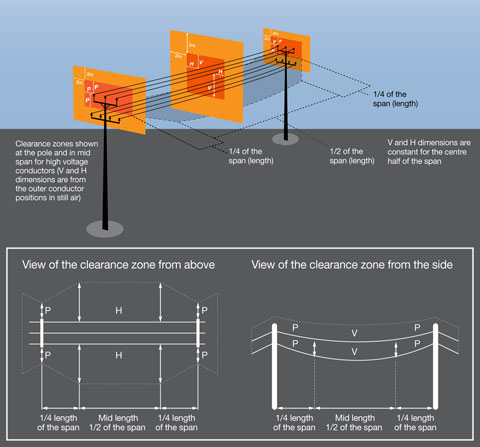
The clearance zone is the minimum safe distance between vegetation and powerlines. This needs to allow for trees and the conductor (wires and cables) to move. For example, wires can swing in the wind, trees can grow up and out.
Larger clearances must be applied if powerlines are in a bushfire risk area.
Responsibilities when living at the property
The person living at a private property – including tenants - must keep clearance zones free of vegetation they have planted around their private supply lines. This also applies if tree branches and vegetation overhang the clearance zones from a neighbour’s land.
If a property isn’t occupied, the owner is responsible.
Responsibilities of the network operator
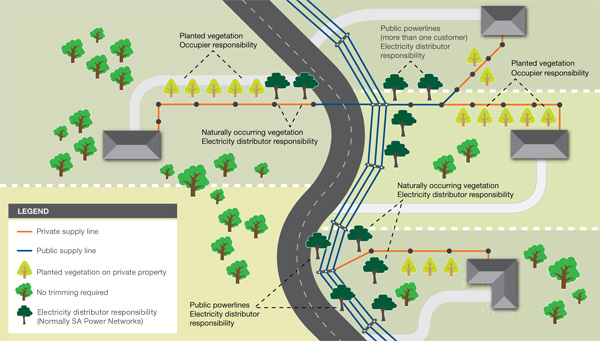
The network operator can clear the vegetation on your property if you don’t maintain the clearance zones. But you will be responsible for the cost of the work.
Clearance zones
To work out the size of a clearance zone, you will need to know:
- if the powerline is in a bushfire risk area - larger distances are required
- the voltage and type of powerline
- wire or cable type – ie, bare or insulated
- the distance between stobie poles or transmission towers
- how far the vegetation is from closest stobie pole.
Insulated conductors - wires or cables
Fully insulated powerlines such as aerial bundled cables (ABC) always require a clearance zone of 10 cm.
Bare or partially insulated wires
Different distances are required vary based on their voltage and for high voltage, how far the wire is from the pole.
- Low-voltage require a 10 cm clearance zone
- High-voltage - Divide the length of the wire between two poles into four sections, the two middle sections require longer clearances. Clearances must be:
- vertical - above and below
- horizontal - both sides.
| Voltage | Clearance at the pole | Span 0-50 m | Span 50-100 m | Span 100-150 m | Span 150-200 m | Span 200-300 m | Span 300-400 m | Span over 400 m |
|---|---|---|---|---|---|---|---|---|
| Less than 1 kV | P: 0.1 m |
V:0.1 m H:0.1 m |
V:0.1 m H:0.1 m |
V:0.1 m H:0.1 m | - | - | - | - |
| 7.6 kV to 11 kV | P: 0.5 m |
V:1.5 m H:1.5 m |
V:2.0 m H:2.5 m |
V:2.5 m H:3.5 m |
V:2.5 m H:4.5 m |
V:2.5 m H:6.0 m |
V:2.5 m H:6.0 m |
V:2.5 m H:6.0 m |
| 19 kV | P: 0.5 m |
V:1.0 m H:1.0 m |
V:1.0 m H:1.0 m |
V:1.0 m H:2.5 m |
V:1.0 m H:2.5 m |
V:1.5 m H:5.0 m |
V:2.0 m H:7.0 m |
V:2.0 m H:9.0 m |
Planting new trees
When planting trees near powerlines you must:
- choose a species that won’t grow into the clearance zone
- plant the correct species at the correct safe distance.
Approved tree species - lists 1 and 2
Planting near overhead powerlines
Trees can be planted within the safe zone if they are listed in the approved species lists 1 and 2.

Planting near underground wires
Trees can be planted within 3 metres of an underground supply line of 66kV or more if they are listed in the approved species lists 1 and 2.

Location of new plantings
The mature height of the tree affects how close it can be planted to different powerlines. All distances apply from the centre line of the powerlines and depend on voltage.
Safe distances are different in bushfire risk areas.
| Voltage | Prescribed clearance distance from the centre line |
|---|---|
| 330kV | 17.0 metres (recommended, as not currently prescribed) |
| 132kV (Excluding single pole lines) | 15.0 metres |
| 132kV (Single pole) | 10.0 metres |
| 66kV | 6.5 metres |
| All other voltages | 6.0 metres |
Buffer zones
A buffer zone is an additional area around a clearance zone that allows for trees to move and grow. It creates a limit on the amount of vegetation a network operator can remove on private land or in the bushfire risk area.
Buffer zones located on private property begin on the outer edge of the clearance zone. They are:
- 2 metres for distribution powerlines
- 3 metres for transmission powerlines.
There is no legal buffer zone for trees and vegetation on public land that is not in a bushfire risk area. But applying a buffer zone will maximise safety.

Calculate a buffer zone
To calculate a buffer zone for bare powerlines in a bushfire risk area, you will need to:
- Draw a line between the outermost point of the wire or cable on one side of the stobie pole and the ground under it. Repeat this on the other side of the stobie pole.
- From where these points reach the ground, draw two slanted lines upwards and at 45°.
- Extend the slanted lines until you can draw a horizontal line five metres higher than the top of the stobie pole.
Working safely near powerlines
You need to be familiar with the safety principles of working near powerlines if you intend to carry out the vegetation clearance yourself.
Working safely near overhead powerlines
Alternatives to clearing vegetation yourself
Access for power line workers
Maintenance workers need safe access to power lines to carry out their work, often in an emergency. Clearance between vegetation and powerlines can help workers restore power quickly and safely. It can also reduce the risk of other emergency services being affected by lengthy outages.
Objections and complaints
SA Power Networks must give the person living at the property (or owner) 30 days' notice of clearing vegetation on a private property. The notice doesn’t apply in an emergency.
- Talk to the network operator if you object to the proposed clearance.
- If you can’t come to an agreement, clarify what must be done with the Office of the Technical Regulator (OTR).
- You can also lodge a written objection with the OTR - within 21 days of receiving the notice.
Related information
Legislation
Electricity (Principles of Vegetation Clearance) Regulations 2021