Carriers for wheelchairs and personal mobility devices are commonly fitted to the rear of vehicles, with the weight of both the device and the carrier supported by the vehicle’s towbar. The information below outlines the key requirements for safe use, including load limits, design standards and other important safety considerations.
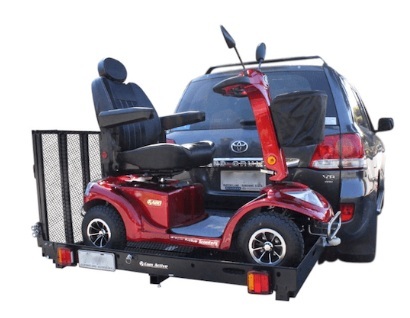
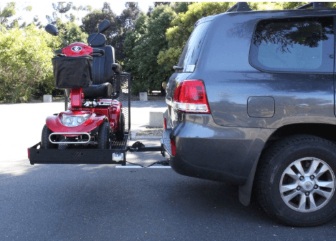
A carrier may be a type manufactured commercially in relatively large quantities, or manufactured in small volumes, or as a ‘one-off’.
This information is not intended to be referred to with respect to the transport of non-essential leisure or pleasure equipment such as bicycles, jet skis, golf carts, etc.
These carriers are also known by a variety of terms such as gopher carrier, mobility scooter carrier, etc
Design and fitting
Towbars are generally designed and rated for the maximum download which may be expected when towing a trailer which does not exceed the permitted mass for the towing vehicle.
The load expressed by carrier is unlike the load expressed by a trailer, particularly the dynamic shock loads due to an uneven road surface.
1. The distributor or seller of any carrier for a wheelchair or personal mobility device must contact Vehicle Standards with details of the carrier design, specifications, loading and guidance for use information for each vehicle and carrier model combination; and, where vehicle model variants exist with differing GVM / GCM ratings, of each variant of vehicle to be used with the carrier.
2. Where any doubt exists regarding the suitability of the carrier and vehicle combination in satisfying these requirements Vehicle Standards may request a professional engineer’s report for any carrier and vehicle combination.
3. The distributor or seller of any carrier for a wheelchair or personal mobility device must provide guidance for the safe use of the carrier which shall inform the purchaser of the safe limitations of use on the purchaser’s vehicle, any special conditions of use of the carrier, and basic maintenance requirements for continued safe use including but not limited to routine checks of lights and load restraints. Such guidance shall be in plain, easily understood English and contain diagrams where appropriate. See below.
4. A metal plate must be affixed to the carrier in a prominent position showing the manufacturer’s and/or distributor’s company name, along with their address or contact number, and the following information stamped alongside each of the headings:
MAXIMUM CARRIER LOAD (kg)MAXIMUM MASS OF VEHICLE (kg)
MAXIMUM OVERHANG (expressed as a percentage of the vehicle wheelbase)
5. The combined weight of the carrier and its load must not exceed the maximum towbar downward load rating specified by the towbar manufacturer.
6. The maximum carrier overhang from the vehicle rear axle allowed is 60% of the wheelbase up to a maximum of 3.7 metres, whichever is the lesser (refer to Figure 1). The wheelbase is the distance between the centre of the rear axle or rear axle group to the centre of the front axle.

Figure 1. Rear overhang limits
7. The carrier ramp shall exit to the nearside of the vehicle – not into the roadway and passing traffic. Ramp exits to the rear will be considered.
8. The carrier must be painted a bright colour or fitted with a suitable retro-reflective material facing to the rear to ensure that it is conspicuous to vehicles following.
9. Protruding edges and corners of the carrier must be rounded so they do not constitute a safety hazard. This also applies to the access ramp when loading and in the travelling position when loaded, and to folding carriers when stowed vertically.
10. Neither the empty nor loaded carrier shall:
- a) obscure any of the vehicle compulsory lighting or reduce the angle of coverage of any vehicle lights below the minimum acceptable angle, otherwise additional approved lighting must be provided. A lighting board similar to that used on a boat trailer, or an equivalent device, is acceptable providing it meets all appropriate regulations.
- b) obscure any part of the vehicle number plate or the compulsory number plate lights, including when a folding carrier is stowed vertically. If it does then the number plate must be mounted on a lighting board similar to that used on a boat trailer, or an equivalent device, and fitted with appropriate number plate lights.
- c) not adversely affect vehicle handling with respect to steering and braking when only the driver is present in the vehicle. The weight of the carrier and wheelchair or personal mobility device must not cause the vehicle to lift at the front to the extent that it causes light steering, poor stability or incorrect headlight alignment. If these symptoms are apparent, an application to modify the vehicle should be made for any proposed adjustments to the rear suspension, or alternatively a vehicle with longer wheelbase may need to be considered.
- d) overload the rear axle and/or tyres of the carrying vehicle, or any other component of the vehicle including the towbar download, the towbar’s system of attachment to the vehicle, or the vehicle structural integrity for the load expressed through the towbar. Allowance must be made for the extra load applied to these components by the dynamic effects of road shocks when the vehicle is travelling at normal speeds. An application to modify the vehicle should be made for any proposed strengthening, adjustments or replacements for the vehicle manufacturer’s original wheel and tyre combinations.
11. For a carrier with a lifting system which lowers to the floor for loading, the carrier table must be fitted with a locking pin, latch, safety chain or similar device to ensure it remains safely in the raised position whilst travelling on the open road. It must be able to support the wheelchair or personal mobility device and carrier should the lifting mechanism fail.
12. If the carrier is designed to fold up vertically behind the vehicle when not in use, the carrier platform must be securely latched when in the vertical position. This mechanism must remain secure both while the vehicle is stationary and under the dynamic effects of road shocks when travelling at normal speeds. Non-folding carriers that are not in use should be removed during periods of vehicle use when the wheelchair or personal mobility device is not intended to be carried.
13. If the carrier is not designed to fold vertically behind the vehicle, consideration should be given to providing a flag and flexible flagpole of a vivid colour of at least 1meter length which can be easily secured to the rearmost extent of the carrier to improve visibility and reduce the trip hazard for pedestrians and other motorists.
14. The carrier must be equipped with adequate means for securing the wheelchair or personal mobility device in accordance with the current Load Restraint Guide.
15. The following notes and illustrations where appropriate should be included in a carrier operating/maintenance guide:
- Clear instruction for safe loading, the safe stowage of the access ramp where fitted, the locking mechanism/s for securing the carrier table safely when raised in the travelling position.
- The location of securing devices, lugs, or tie-down points and clear direction that the wheelchair or personal mobility device must always be properly restrained to the carrier table when the vehicle is being driven.
- Fold-up carriers shall be securely latched in the vertical position when not in use, and non-folding carriers must be removed when no wheelchair or personal mobility device will be carried that day.
- For those carriers equipped with a flagpole and flag, the flagpole and flag should be mounted on the carrier when the car is parked with the wheelchair or personal mobility device removed.
- Any other checks that should be made for safe continued use of the carrier on that vehicle variant, and how to report any issues of concern, for example reporting handling issues, also damage or cracks to carrier or towbar, etc.
Also, to highlight the need to exercise caution when driving a vehicle with a wheelchair or personal mobility device on the carrier on an uneven road surface, as this may cause vehicle instability to increase.
Vehicle Standards reference: MR1716.