Ex-Australian Defence Force (ADF) surplus vehicles are often on-sold to the public after they've completed their military service. When used by ADF these vehicles often operate under registration exemptions designed to allow a greater degree of flexibility required by the ADF.
Often these vehicles are built, modified, or equipped for specialised miliary use in a way that's not suitable for road use and is not compliant with Australian Design Rules (ADRs) which apply road use vehicles.
To be registered in SA, these vehicles must comply with the applicable vehicle standards. This page provides general guidance to anybody who is considering buying and registering such a vehicle in SA.
Please note:
- many ex ADF vehicles can't be road registered, for example, vehicles built after 1932 must have pneumatic tyres. Tanks and armoured vehicles are not eligible for registration and must be floated to and from events/displays etc.
- under the SA Road Traffic Act 1961, passengers must not be transported in an open load space, with or without rear seats. It's an offence to allow person/s to ride in an open load space whether seated or not.
This page can assist if you plan to purchase a vehicle for road use from disposal sales, and help you to understand some of the key issues of meeting applicable SA roadworthy requirements.
Before you buy, we recommend you consult an LVES to ensure the vehicle can be modified to make it compliant. Some vehicles can't be made compliant at all and necessary modifications may be cost prohibitive.
Registration requirements
Vehicle identification
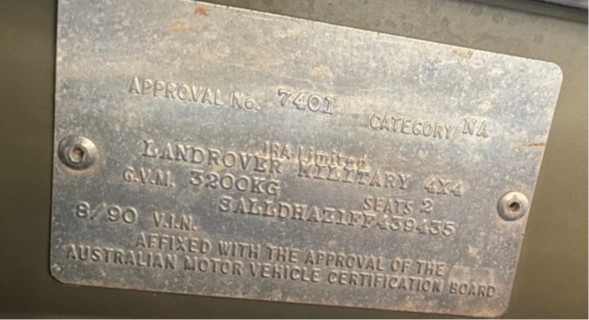
The following vehicles must be fitted with an Australian Design Rule (ADR) compliant Australian Identifications plate and/or entered on the Register of Approved Vehicles (RAV) –
- motor vehicle built after 1st May 1971
- motorcycle built after 1st October 1977
- trailer with an Aggregate Trailer Mass (ATM) of over 4.5 tonnes built after 1st July 1988.
For more information see ADR61 - vehicle marking
A trailer with an ATM of up to 4.5 tonnes must be fitted with a trailer plate. For more information see VSB1 - 13 General requirements, 13.1.1 vehicle plate.
Vehicles will be subject to an identity inspection, and we'll check the compliance plate and RAV entry applicable to the age of the vehicle. If a vehicle doesn't have either of these, it may not be registerable.
Where a vehicle does not have an appropriate plate, or the plate can't be read:
- you can request a replacement Australian Identification plate from the manufacturer or their agent, or
- submit an application for exemption from fitting of a compliance plate .
Please note that some ex-forces vehicles may be fitted with an identification plate indicating that this is a military vehicle, or that only select and limited road vehicle standards were met when manufactured, and this may not be an acceptable indication that this is an ADR compliant road vehicle.
Roadworthy requirements
All ex-ADF vehicles may need to pass a roadworthy inspection.
You should also consider the following areas that have been identified as possibly requiring further attention.
- Vehicle dimensions - all ex-ADF vehicles and trailers must comply with appropriate ADR 43 vehicle dimension requirements.
- Seat belt anchorages and roll over hoops – in the absence of any ADF certification for the upper front seat belt anchorages and roll over hoops, additional independent engineering certification may be required.
- Roll hoop padding requirements (occupant protection) - all components of the roll-over protection device in the passenger area that lie within the defined head space area must be covered by padding that meets the padding specifications outlined on MR864 Internal padding material for occupant protection.
- “Black out” (lighting) mode is not suitable for on-road use. Australian Vehicle Standards Rules state that brake lights must operate when the service brake is applied, regardless of any selected lighting mode. All lighting must meet with the applicable position and performance requirements.
- Tools and accessories must not be secured on the bonnet (spare tyre exempt). Items such as tool racks, jerry-can mounts, and similar fittings must not interfere with the operation or visibility of essential vehicle systems, including lights and driver vision, and must not pose unnecessary risks to pedestrians or other road users. For example, winches and lift/recovery points on UNIMOGs must be removed due to the risk they pose. Any additional accessories must be fitted in accordance with MR800 Hazardous projections.
- An ignition key/lock or vehicle immobiliser should be fitted. Without this item, the vehicle may not be able to be covered under a contract of insurance (check with your insurer).
- Lockable door handles should be fitted or the vehicle may not be able to be covered under a contract of insurance (please check with your insurer).
- Stability and performance - some of these vehicles were raised by an average 100 mm above manufacturer design ride height to increase the break over angle achieved mid wheelbase. This modification may have resulted in a vehicle that has unpredictable handling resulting from a combination of body roll induced axle steer, non-linear spring return and negative front axle castor trail. Testing will need to be conducted or reported by an LVES with respect to any such vehicle.
Ex-Australian Defence Force light trailers
All ex-ADF light trailers must adhere to the same requirements as other trailers in SA to be eligible for registration. The applicable standards vary according to the trailer’s build date. For more information see Vehicle Standards Bulletin 1.
Heavy ex-Australian Defence Force vehicles
The same requirements for a compliance plate or RAV entry apply to ex-military heavy vehicles as well. For information about heavy vehicles and modifications, see National Heavy Vehicle Regulator webpage on heavy vehicle modifications.
Heavy ex-Australian Defence Force trailers
Heavy trailers must comply with all appropriate standards, including: applicable ADR 61 requirements and display an approved identification plate in accordance with the Motor Vehicle Standards Act 1989 or the Road Vehicle Standards Act 2018.
All heavy trailers must comply with the dimension prescribed in ADR 43
Before purchasing any non-standard or over dimensional trailer you should:
- consider whether the manufacturer was granted approval to manufacturer and supply a non-standard trailer to the market or only to the defence forces as a service vehicle, and
- confirm that a non-standard or over dimensional trailer will be granted access by the relevant road managers.
Before purchasing any non-standard or over dimensional trailer, please be aware that these trailers may require significant modification prior to being suitable for registration, for example if they exceed the current maximum prescribed width (2.5m).
Permanently coupled trailers such as generator sets coupled to communication vehicles are treated as a separate trailer and may not meet applicable ADR/ roadworthy standards.
Related information
On this site
MR864 Internal padding material for occupant protection
Other sites
Vehicle Standards reference: MR1721