On this page
A Removable Front Frame Rack (RFFR) is an assembly mounted on a vehicle’s front bumper or bull bar/nudge bar, comprising two vertical members (posts), and a horizontal member (bar) spanning the posts, that is used to support the front end of a load fitted along the vehicle’s length.
This information page is intended as a general guide to the safety and legal requirements that apply to fitting RFFR to the front of a light motor vehicle
Vehicles detected with Front Frame Rack installed when not carrying loads or meeting the requirements listed below may be defected.
General requirements
RFFR are also known by a variety of terms, including plumbers’ racks, builders’ racks, ladder racks and H-racks. A typical RFFR is shown below in Figure 1.

Figure 1: A typical RFFR on a working utility vehicle
Design and fitting
Fitting any rigid equipment to the front of a vehicle may affect the performance of the devices which provide passenger protection in the case of an impact.
The RFFR and vehicle must be compatible, and a RFFR should be designed and manufactured for the vehicle model to which it is fitted.
In particular, the mounting structure must be able to support the fully loaded RFFR; and the fully loaded RFFR does not overload the vehicle’s front axle.
RFFR must be compliant with the vehicle’s airbag system.
Information stating a RFFR’s compatibility with a vehicle model should be available at the supplier.
The height of the load bearing rail of the RFFR should align well with other load bearing devices fitted to the vehicle, such as roof rails or a similar rear mounted rack.
Mounting instructions should be provided with the RFFR, along with the mass of the RFFR and the maximum load the RFFR can support. This information should be indelibly marked or labels fixed in a prominent position.
There are a few specific requirements that must be observed when choosing and fitting an RFFR to a vehicle, including:
- The RFFR must be designed, manufactured and fitted to the vehicle in a way that minimises the likelihood of injury to a person making contact with the vehicle.
- There must be no pointed or sharp edges.
- To meet these requirements, the components should ideally be fabricated from cylindrical sections, be free of burrs and should not have any sharp edges.
- The RFFR must be installed in accordance with the manufacturer’s instructions.
- The RFFR must be mounted, either directly or on brackets, on or behind the supporting bumper or bull bar/nudge bar. No part of the RFFR or brackets should extend forwards beyond the bumper or bull bar/nudge bar.
- Brackets connecting the RFFR to the vehicle should not protrude above the top of the bumper or bull bar/nudge bar.
- The RFFR must be properly secured to the mounting structure.
- The RFFR must be fitted to ensure the driver has a clear view of the road ahead as far as reasonably practicable.
- The RFFR and mounting brackets must not obscure the vehicle’s front number plate, statutory lighting, or forward-facing sensors associate with an ADAS system.
Use
RFFR are typically used to carry relatively light loads on vehicles like utilities rather than in packing them in larger, heavier vehicles. It is important to ensure the load can be safely carried on the RFFR, and there are a number of precautions that should be observed to help ensure the task does not create a road safety risk to the vehicle’s occupants and other road users. You must know the mass and overall length of the load, as this will determine whether the RFFR can be used, and how the load is to be placed and supported.
- The RFFR must be capable of safely supporting the load placed on it.
- The combined mass of the load and the RFFR must not overload the vehicle’s front axle and must not overload the vehicle.
Details of a vehicle’s overall load carrying capacity and the load distribution on the different axles should be in the vehicle user’s manual and available from the vehicle manufacturer.
The load being carried on any vehicle must not project more than 1.2 metres forward of the vehicle, see Figure 2:
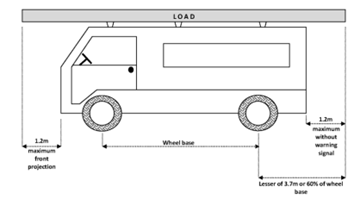
Figure 2. Front and rear projection limits
The maximum rear overhang allowed is 60% of the wheelbase up to a maximum of 3.7 metres measured from the centre of the rear wheel, whichever is the lesser, and no more than 1.2 metres beyond the rear of the vehicle. (The wheelbase is the distance between the centre of the rear axle or rear axle group to the centre of the front axle).
For detailed information on overhang limits, side projections and carrying load on light vehicles, see light vehicles carrying loads.
- The load must be securely attached to the RFFR and other supporting devices fitted to the vehicle, such as the roof rails or a similar rear mounted rack.
- The load must be arranged so it does not distract or prevent the driver from safely driving or controlling the vehicle.
If the RFFR or vehicle do not meet any of these requirements, an alternative must be used to transport the load.
RFFR should be removed when not being used to transport a load.
Safety checklist
When carrying load, ensure that:
- the total mass of the load and vehicle does not exceed the vehicle’s Gross Vehicle Mass
- the load is correctly balanced and restrained so that there is no movement with braking or cornering
- securing devices such as ropes and lashings are tight and not likely to lose tension with travel
- the load being carried does not exceed the length and projection limits
- the load does not present any danger to other people or property if it projects past the body, even if it meets all the dimensions and safety requirements.
Vehicle may get defected if:
- The RFFR does not meet the specifications outlined above
- The vehicle is used contrary to the safety requirements outlined above.
Vehicle Standards reference: MR1711.